
Music theory topics can take a while to ‘click’. One important topic is the notes in the various keys and particularly the sharps and flats in each key.
You may have already learned that the key of C has no sharps/flats, G has 2, D has two, etc. but where does this particular order come from?
It really helps to visualize this, first have a look at the C major scale in the graphic below. It starts at C, a tone up to D, tone up to E, semi tone up to F, tone up to G, tone up to A, tone up to B and finally a semi tone up back to C.
So what happens if we want to have a new scale, by raising just one of these notes? We will find the key with one sharp, but which is it? Give it a try and try to raise any of the notes a semi tone and see what you end up with!
Most of the time we end up with something that is no longer a major scale, but if we raise F to F# we still have the same pattern, it just shifted to the right and we have a new major scale starting at G.
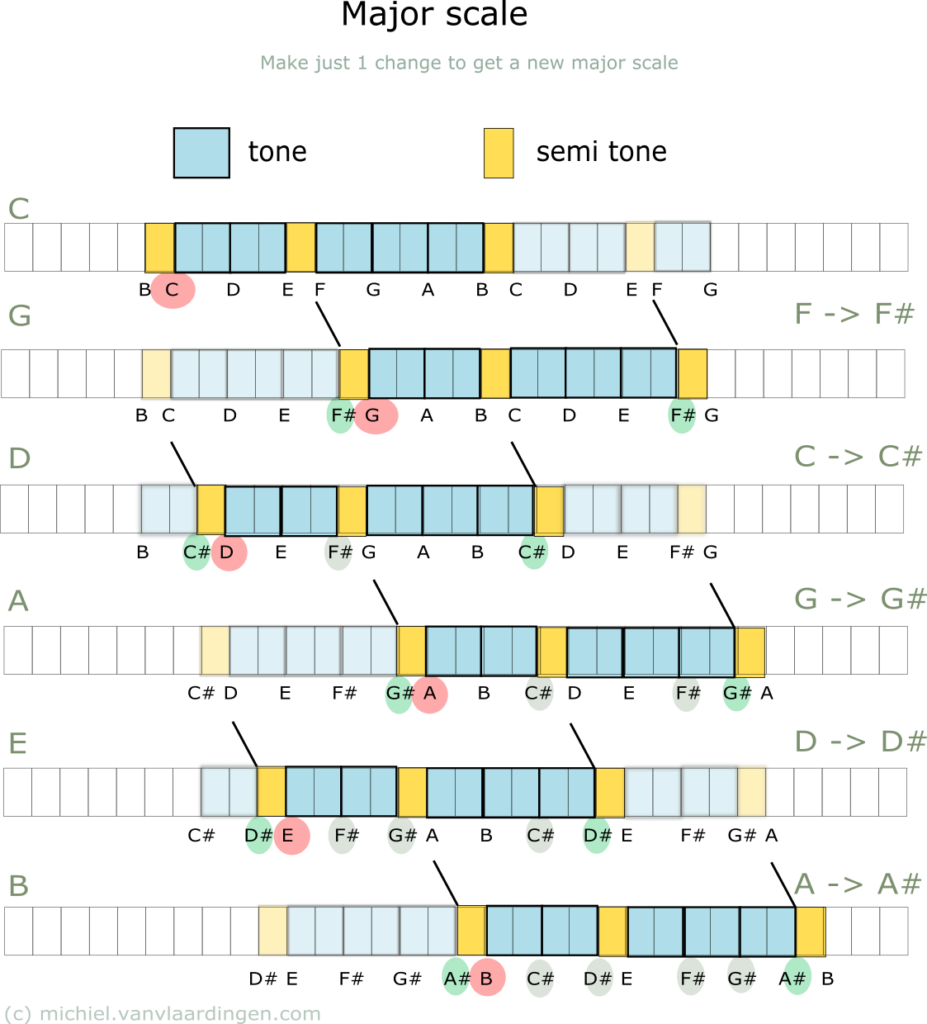
Now that we have a way of turning a major scale into another by just raising one of the notes by a semi tone, we can repeat the same trick: the note to raise is always 5 semitones above the starting point, we raise it by a semitone and we can see the new key starts 7 semi tones above the previous one which is also a 5th (indicated in red). So each time we go up a 5th to find the next key, this is often represented by the circle of fifths.
Leave a Reply